

How AI Is Reshaping Vietnam’s Retail Industry: Insights from Event Retail Next 2026
AI Is No Longer the Question. Business Value Is the Answer.
Over the past few years, AI has become one of the most talked-about topics in the retail industry. From global conferences to boardroom strategy discussions, AI has been at the center of conversations around business growth, operational excellence, and customer experience.
What is even more notable is that the questions businesses are asking have changed.
Instead of asking, “What is AI?”, retailers today are asking far more practical questions:
- How can AI help businesses drive revenue growth?
- How can every technology investment deliver measurable business value?
- Where should businesses begin their AI journey?

The event opened with a comprehensive overview of Vietnam’s retail landscape, highlighting evolving consumer behavior, the rapid growth of omnichannel retail, and increasing competitive pressures. These insights provided valuable market context, helping businesses better understand the industry’s challenges before exploring the role of technology, data, and AI.
These were also the key themes explored throughout Retail Next – Winning in Vietnam’s New Retail Landscape with AI and Data, which brought together retailers, the Vietnam Retailers Association (AVR), SAP, and industry experts to share diverse perspectives on the future of Vietnam’s retail industry.
What made Retail Next unique was not the introduction of another new technology, but the opportunity to bring together diverse perspectives on the same challenge. From retailers navigating growth and operational pressures, to technology leaders, consulting experts, and industry associations, one message stood out: AI creates real business value only when it is built on a foundation of trusted data and standardized business processes.
Vietnam’s Retail Industry Is Entering a New Era
For many years, growth in Vietnam’s retail industry was largely driven by expansion—opening more stores, entering new markets, and increasing the number of retail outlets.
Today, the landscape has changed.
Consumers have more choices than ever before, and shopping behaviors continue to evolve across physical stores, e-commerce platforms, and social commerce channels. At the same time, retailers are facing increasing pressure on profit margins amid intensifying competition and rising operating costs.
In this new environment, growth is no longer simply about selling more.
Success today depends on selling the right product to the right customer, at the right time—while maintaining optimal inventory levels.

The event opened with a comprehensive overview of Vietnam’s retail landscape, highlighting evolving consumer behavior, the rapid growth of omnichannel retail, and increasing competitive pressures. These insights provided valuable market context, helping businesses better understand the industry’s challenges before exploring the role of technology, data, and AI.
As a result, data has evolved from a reporting asset into a strategic business asset.
Data Has Become the Foundation of AI Success
One of the key messages echoed throughout Retail Next was:
AI doesn’t replace data. It unlocks the value of data.
Many organizations are eager to adopt AI, yet they continue to face fundamental challenges such as fragmented data across ERP, POS, CRM, and warehouse systems, inconsistent business processes, and data that is not yet reliable enough to support AI-driven decisions.
In such environments, AI cannot consistently deliver accurate or reliable results.
Instead of enabling better decisions, AI simply learns from incomplete or unstandardized data.
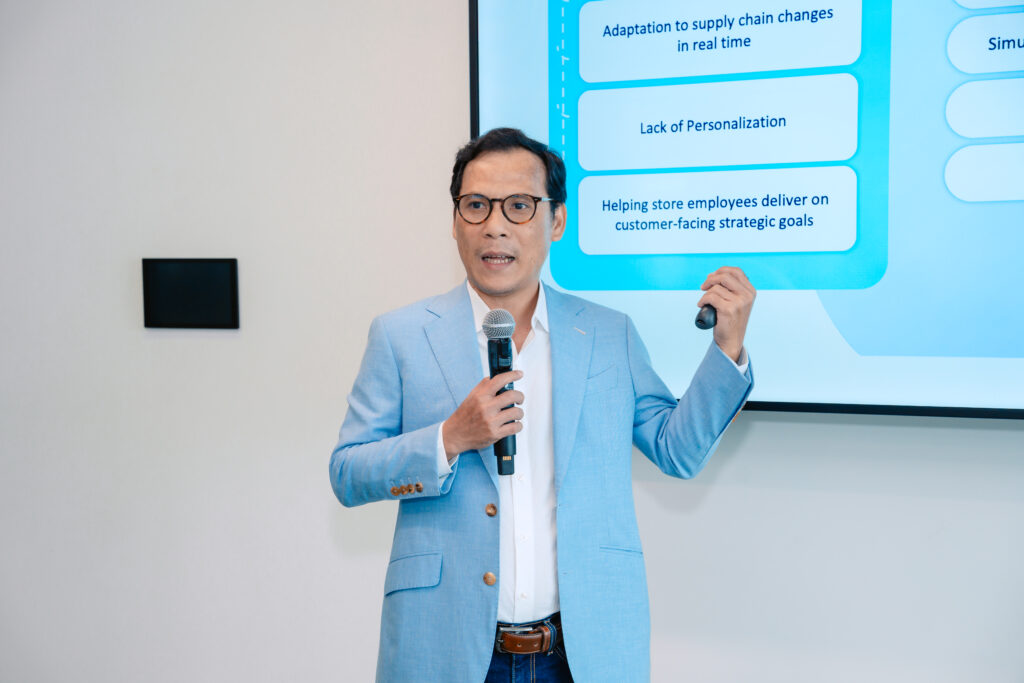
One of the topics that resonated most with attendees was the role of data and standardized business processes in successful AI adoption. Speakers emphasized that AI cannot deliver reliable outcomes when data remains fragmented or business processes lack consistency. This is why many organizations are prioritizing a strong data foundation before scaling their AI initiatives.
This is why organizations that succeed with AI typically begin by standardizing their data and business processes before scaling AI across the business.
Where Is AI Creating Value in Retail?
Unlike a few years ago, when AI was primarily associated with chatbots and content generation, today it is being applied directly to the core operations of retail businesses.
Some of the areas where AI is already delivering measurable value include:
- Demand forecasting: Enabling businesses to predict customer demand more accurately, improving procurement planning, inventory management, and production planning.
- Inventory optimization: Reducing excess inventory, minimizing stockouts, and improving inventory turnover.
- Promotion planning: Analyzing the effectiveness of promotional campaigns to maximize revenue and profitability.
- Customer personalization: Delivering personalized product recommendations and tailored promotions based on each customer’s preferences and behavior.
- Store operations support: Empowering store teams with faster access to information and helping them make better, more informed decisions.
- Real-time analytics: Providing business leaders with real-time insights to monitor performance and respond more quickly to changing market conditions.
The common thread across these applications is that they are not designed to replace people, but to empower them to make faster, more informed decisions.
What businesses need is not more AI.
One key takeaway from Event Retail Next: Businesses don’t invest in AI for the sake of AI. They invest in business outcomes. Business leaders are not concerned with how many AI models are running.
What they care about are measurable business outcomes:
- How much has revenue increased?
- How much has profitability improved?
- How much has the stockout rate been reduced?
- How much has inventory turnover improved?
- Can employees make faster, better-informed decisions?
These are the metrics that truly define the value of digital transformation.
From Technology to Business Value
After years of partnering with retailers on their digital transformation journeys, TDI APJ has observed one consistent pattern: the most successful projects rarely begin with the question, “What technology should we use?” Instead, they start with a clear business challenge that needs to be solved.
- How can we forecast demand more accurately?
- How can we reduce stockouts while maintaining optimal inventory levels?
- How can we shorten decision-making time when business data is scattered across multiple systems?
- How can every technology investment deliver measurable business impact—whether through higher revenue, improved profitability, or greater operational efficiency?
Only after these business objectives are clearly defined can organizations choose the right technology platform, standardize their business processes, and apply AI in ways that deliver measurable business value.
This is why many organizations are shifting their focus from simply implementing AI to building the data foundation and operational capabilities that enable AI to deliver real business value.
With more than 28 years of SAP implementation experience across Vietnam and Southeast Asia, TDI APJ approaches digital transformation by starting with each customer’s business challenges—not technology. By combining SAP, deep retail expertise, and innovations from TDI AI Studio, the goal is not simply to deploy a new system, but to help retailers build an integrated operating foundation, establish trusted data, and enable faster, more confident decision-making in an increasingly dynamic market.
Ultimately, the value of AI is not defined by the sophistication of its algorithms, but by its ability to help businesses make better decisions, respond faster, and deliver measurable business outcomes.
Retail Next Event is only the beginning of the conversation.
Retail Next may have concluded in just one afternoon, but the conversations it sparked are far from over. How can AI deliver real business value instead of remaining just another technology trend? Should organizations invest in data foundations before AI? Which use cases can generate business impact most quickly?
There is no one-size-fits-all answer.
However, one message resonated across nearly every session at Retail Next: competitive advantage in the years ahead will not come from adopting more technology—it will come from turning technology into measurable business outcomes.
If your organization is exploring how to accelerate growth through data and AI in retail, we’d love to continue the conversation. Connect with the TDI APJ team to discuss your business challenges, exchange practical insights, and build a transformation roadmap that turns technology investments into measurable, long-term business value.