

Digital Transformation in Manufacturing in Vietnam: From Global Pressure to Practical Action on the Factory Floor
Vietnam is emerging as one of Southeast Asia’s leading manufacturing hubs. Continued FDI inflows, particularly from Japan, South Korea, and Europe, have turned major industrial parks such as Thang Long, VSIP, and Amata into complex manufacturing ecosystems with dozens of factories operating in parallel. In this context, the pressure for digital transformation in manufacturing no longer comes from technology trends, but from real competitive demands on the production line.
Vietnam: a new destination for global manufacturing and the challenge of digital operations
Driven by the “China+1” strategy, a growing number of multinational manufacturers have expanded or shifted production to Vietnam. According to the Ministry of Planning and Investment, processing and manufacturing has consistently attracted the largest share of registered FDI, underscoring Vietnam’s increasingly strategic position in global supply chains.
However, rapid expansion also brings significant operational challenges: fragmented data across factories, inconsistent management systems, and a wide gap between reports submitted to HQ and the actual situation on the factory floor. This is not one company’s problem. It is a shared challenge for most FDI manufacturers.
Cloud ERP: the foundation of digital transformation in manufacturing
In the wave of manufacturing digital transformation, Cloud ERP, especially SAP Cloud ERP (deployed through SAP GROW or RISE with SAP), is being chosen by many manufacturing groups. Unlike traditional on-premise ERP, Cloud ERP enables businesses to:
- Gain full visibility: connect real-time data from the factory floor to management dashboards and HQ reporting.
- Scale quickly: deploy across multiple factories and countries on a single platform without duplicating IT infrastructure.
- Connect factory systems: integrate with IoT, Manufacturing Execution Systems (MES), and other operational systems.
- Meet security and compliance standards: especially critical for Japanese and European manufacturers.
However, successfully implementing Cloud ERP in Vietnam’s manufacturing environment requires more than choosing the right technology. Businesses must solve the challenge of “global standards vs. local needs”: balancing the process standardization required by headquarters with the operational, legal, and workforce requirements of the Vietnamese market.
2-Tier ERP: a model for FDI enterprises
A specific challenge for multinational manufacturers is the 2-Tier ERP architecture: headquarters runs a corporate-level ERP, often SAP ECC or SAP Cloud ERP, while subsidiary factories in countries such as Vietnam need a more flexible system that fits their scale and local requirements, yet still connects with the parent system.
This model is widely used by Japanese and South Korean manufacturers with FDI factories in Vietnam. Implemented well, 2-Tier ERP achieves a difficult balance: global standardization with local flexibility. Read more: What is two-tier ERP and when does a group need it?
Smart Factory and IoT: the future is getting closer in Vietnam’s industrial parks
Alongside Cloud ERP, Smart Factory and Internet of Things (IoT) technologies are becoming increasingly common across Vietnam’s major industrial parks. Smart sensors on production lines, real-time equipment monitoring, and production data analytics are helping manufacturers to:
- Predict equipment failures before they occur, reducing unplanned downtime
- Monitor product quality at every stage of production in real time
- Optimize energy and material usage based on actual operational data
- Build a reliable data foundation for automated reporting to management and HQ
Integrating IoT with Cloud ERP, particularly on SAP, is creating a new layer of connected data for manufacturers: from machine data to financial data, all on a single platform.
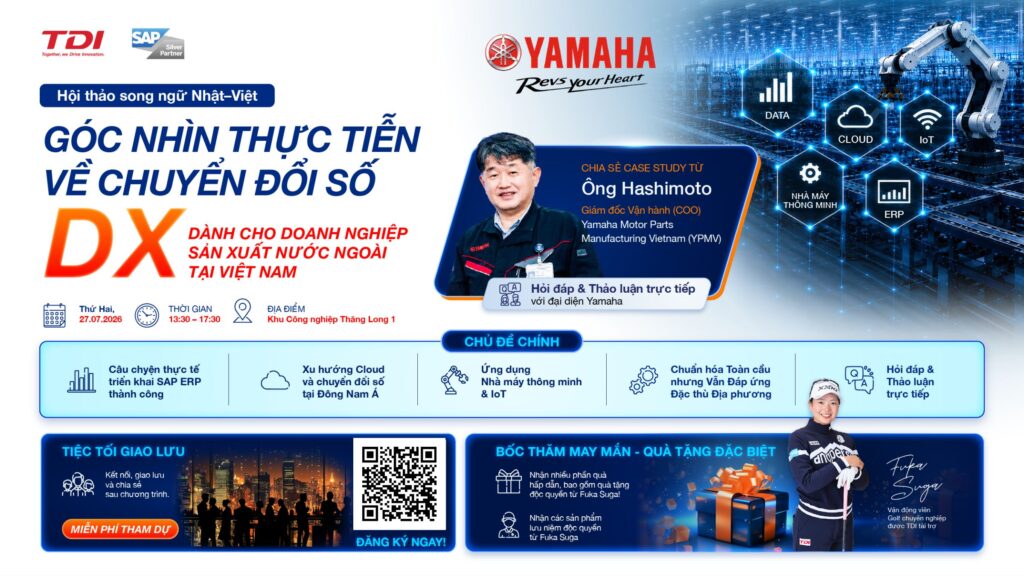
Proof in practice: Yamaha Motor Parts Manufacturing Vietnam (YPMV)
These trends are no longer theoretical. Yamaha Motor Parts Manufacturing Vietnam (YPMV), a Yamaha parts manufacturing plant in Vietnam, is one of the FDI manufacturers that has successfully implemented Cloud ERP in a live production environment. The journey involved solving system integration challenges, balancing the requirements of its Japanese HQ with local operations in Vietnam, and keeping production running throughout the transition.
Mr. Hashimoto Muneki, COO of YPMV, led this transformation directly, and his story reflects the real challenges many FDI factories in Vietnam face today. Read the full story: YPMV builds a unified management system on the cloud.
Seminar “Practical DX Insights in Manufacturing” (July 2026)
In July 2026, TDI APJ and SAP co-hosted the seminar “Practical DX Insights in Manufacturing” at Thang Long Industrial Park I, Hanoi, with Mr. Hashimoto and representatives from YPMV. The Japanese–Vietnamese bilingual seminar covered four topics: DX and cloud trends in Southeast Asia, the YPMV Public Cloud ERP case study, the 2-Tier ERP challenge of global standards vs. local needs, and the outlook for Smart Factory and IoT applications.
It was not a product pitch, but a session with people who have done the work: what worked, and what did not, when implementing digital transformation on the factory floor.
About TDI APJ
TDI APJ is an SAP partner providing SAP ERP consulting and implementation for businesses in Vietnam, Malaysia, and Singapore. With experience delivering projects for FDI manufacturing companies, TDI APJ provides services from strategy consulting and solution design to the implementation and operation of SAP Cloud ERP in real-world environments.
Contact TDI APJ to discuss the digital transformation roadmap for your factory.