

Two-Tier ERP: One Group Doesn’t Always Need One ERP
For years, group ERP programs have chased one goal: one ERP, one template, one way of working for every company. There are good reasons for it. Headquarters gets one view of the numbers, tighter control and lower running costs over time.
But does a 50-person subsidiary need every process designed for a parent company with thousands of staff? Should a newly acquired company drop a system that works well just to follow the parent’s template? Between “force the template” and “let everyone do their own thing”, there is a third option: two-tier ERP.
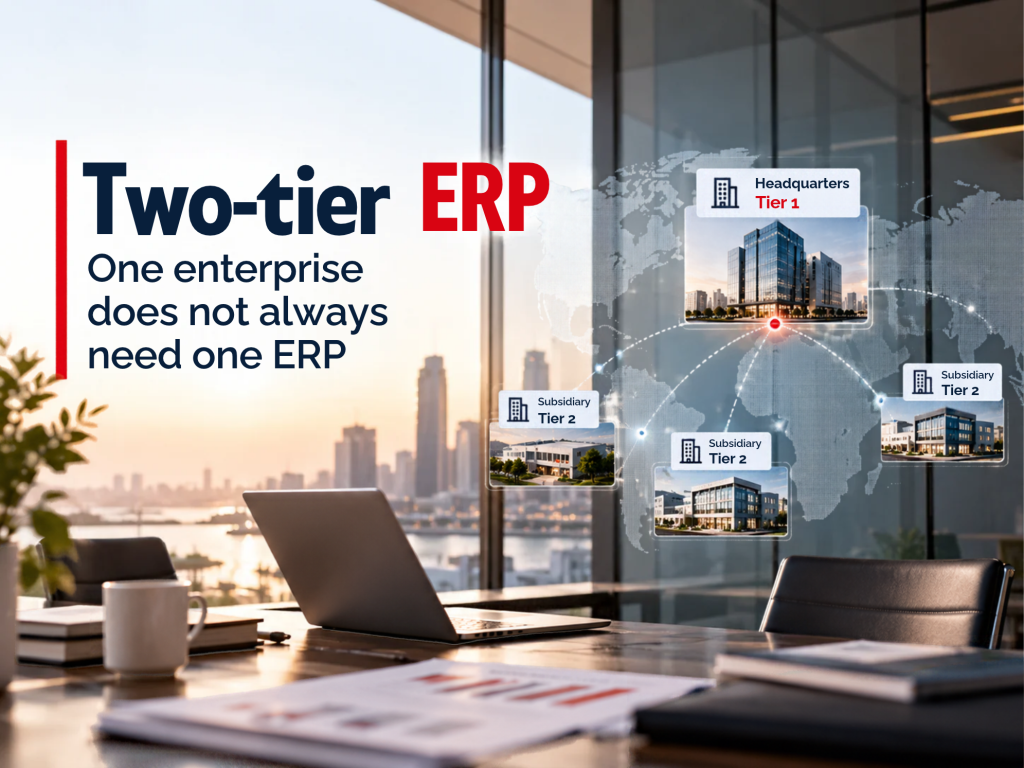
What is two-tier ERP?
Two-tier ERP is a model in which a group runs two connected layers of ERP:
- Tier 1: a full ERP at headquarters and large business units, where processes are complex and control must be tight.
- Tier 2: a lighter ERP, usually in the cloud, for subsidiaries, sales offices, newly acquired companies or joint ventures. Key data, especially finance, flows back to tier 1.
In the SAP world, subsidiaries typically run SAP Cloud ERP in the public cloud, or SAP Business One if they are small.
Why are more groups choosing two-tier ERP?
When headquarters rolls out one template abroad, the gap with local needs usually shows up in four places:
- Speed and timing: the parent’s plan does not match when the subsidiary needs a system.
- Cost and ROI: deploying and supporting a large system costs too much for the subsidiary’s size.
- Law, tax and employee benefits: every country is different.
- Business practices: how companies sell, collect payment and work with distributors in Southeast Asia differs from headquarters.
According to a 2024 ERP market study, 75% of global rollouts that put every company on one shared system (single-instance) face serious delays, budget overruns or operational problems. More than half of global companies are considering or already using a multi-tier ERP model to close these gaps.
Three changes make two-tier ERP easier than before:
- Cloud SaaS ERP lets a subsidiary go live in a few months, at a much lower cost than a large system.
- Integration technology (APIs) makes it easier to sync financial data between different systems.
- M&A and new market entry need speed. After an acquisition, getting a working system in place quickly often matters more than imposing the parent’s template at once. The principle is “tight where it must be, loose where it can be”.
The real question: where do you draw the line?
Choosing the software for each tier is only half the story. The bigger question is: what must be the same across the group, and what is better left to the subsidiary?
A simple test:
- Standardize what the group must compare, consolidate or answer for: the chart of accounts, customer and supplier classifications, intercompany rules and access rights.
- Leave to the subsidiary what depends on local law, local customers or local scale: tax documents, warehouse routines and statutory reports.
- Review the middle ground carefully. For each exception, ask: does it serve the business, or only the habits of whoever built it?
The line is not a single line. It runs across five areas:
| Area | Usually standardized by the group | Usually handled by the subsidiary |
|---|---|---|
| Process | Financial consolidation, intercompany transactions | Warehouse and sales processes that follow local market needs |
| Data | Shared master data: global products, customers and suppliers, with a clear owner | Data used only locally |
| Technology | How systems connect, security standards | Supporting apps used only locally |
| Compliance | Group policies and internal controls | Tax, invoicing and statutory reporting in each country |
| Decision rights | Who can change the shared core, who approves exceptions | Day-to-day operating decisions |
The last area is the hardest. Deciding who decides is a job for senior leadership, not the integration team.
Tiering subsidiaries by size and role
Not every subsidiary needs the same system. A practical way to group them:
| Subsidiary group | Example | Suitable approach |
|---|---|---|
| Large, with manufacturing | A main plant closely tied to the parent’s supply chain | Share the same ERP as headquarters |
| Mid-sized, mainly sales or distribution | A sales company or distribution warehouse | A lighter cloud ERP connected to headquarters |
| Small | A representative office or new start-up entity | A compact, fast-to-deploy ERP, or no separate ERP yet |
Keep the shared core as small as possible: only the data needed for consolidated reporting and the governance rules that cannot be broken. Requirements outside the core (law, tax, local business practice) are handled locally according to their importance. Invite the subsidiary’s business leaders into the project from the start.
Two-tier ERP is not automatically simpler
Without shared governance rules, a two-tier model can easily create:
- Duplicate master data: one customer, a different code in each system.
- Different charts of accounts, so consolidation takes days of manual reconciliation.
- Intercompany transactions that do not match.
- Internal controls that differ from company to company.
- The same KPI, such as “active customer”, defined differently by each subsidiary.
There are two opposite ways to fail. In the first, headquarters copies all its complexity into tier 2: the subsidiary runs a different system but has no real freedom. In the second, subsidiaries get too much freedom and tier 2 becomes a set of disconnected systems that cannot talk to each other.
A practical path for newly acquired companies
After an acquisition, the reflex is either to move the new company onto the parent’s system at once or to leave it alone. Neither should be the default. Its own manufacturing processes may be the very reason the company was bought, and forcing them into the template can destroy the value that was paid for. A more practical path:
- Keep the processes that work well.
- Agree on governance rules: the chart of accounts for consolidation, access rights and security policies.
- Connect the critical data first, usually finance and master data.
- Standardize step by step, one process at a time.
- Only then decide what needs to move onto the group’s shared system.
The line between the tiers can also move. Subsidiaries grow, rules change, the group may centralize purchasing or need consolidated data for AI. Document where the line sits today and how it can shift without rebuilding everything.
When is two-tier ERP not the right fit?
- The subsidiary is a large plant tightly linked to the parent’s production planning and supply chain. Sharing the tier-1 system usually works better.
- The group has no people or processes yet to manage master data and the link between the two tiers.
- Differences between subsidiaries are mostly habits, not driven by law, scale or business model.
How TDI APJ helps
TDI APJ is an SAP Silver Partner and part of the TDI Group in Japan, with more than 300 SAP projects in over 15 countries. We support both approaches:
- Rolling out the parent’s SAP template to subsidiaries in Vietnam, Malaysia, Singapore and Indonesia. We align timing and scope with headquarters and handle the local requirements the template does not cover.
- Implementing tier-2 ERP with SAP Cloud ERP in the public cloud (GROW with SAP), connected to the parent’s SAP system, or SAP Business One for small subsidiaries.
We also configure local accounting, tax and e-invoicing for each country, and bring local leaders into the project from day one.
Deciding between a template rollout and two-tier ERP for your subsidiaries? Talk to our team.
Frequently asked questions
How is two-tier ERP different from a template rollout?
A template rollout puts the subsidiary on the same system as headquarters. Two-tier ERP gives the subsidiary its own lighter system and connects only the data headquarters needs. Many groups use both: a rollout for large subsidiaries and two-tier ERP for smaller ones.
Why use SAP for both tiers?
When headquarters already runs SAP, using SAP at tier 2 makes integration easier thanks to SAP’s ready-made integration scenarios. Data and reports across the two tiers are also more consistent.
How are subsidiaries’ financials consolidated?
Financial data from tier 2 is synced to the parent’s system for consolidation. The most important condition is a shared set of rules for the chart of accounts and master data.
Can a subsidiary move from tier 2 to tier 1 later?
Yes. As a subsidiary grows or needs closer links with headquarters, the line can move. A clear integration design from the start makes this less costly.