

SAP Rollout & Localization in Southeast Asia
An SAP rollout extends an existing SAP template (the group’s standard SAP design) to a new country or subsidiary. In Southeast Asia, most of that work is localization: making the template meet each country’s accounting, tax and e-invoicing rules. Several of these rules changed in 2025 and 2026, so a setup that was compliant two years ago may not be compliant today.
This guide explains what to localize in Vietnam, Malaysia, Singapore and Indonesia, which rule changes to plan for, and how to run the rollout step by step.
What is an SAP rollout?
An SAP rollout takes a proven SAP design and deploys it to a new country, plant or company. The group keeps one core template with shared processes, master data and reporting. Each new entity adds only what local law or a different business model requires.
Companies usually start a rollout when they:
- Open or acquire a subsidiary in Southeast Asia
- Replace local accounting software at subsidiaries with the group’s SAP system
- Move several country entities onto SAP Cloud ERP or SAP Cloud ERP Private as part of a regional program
Global template vs. local requirements: what to keep and what to change
The rule of thumb: keep the shared template, and change it only for a clear reason. There are two valid reasons: local law requires it (accounting, tax, invoicing), or the subsidiary’s business model is genuinely different, for example a sales-only parent with a manufacturing subsidiary in Vietnam. Practical local differences also need attention: language, banks and common payment methods, payroll and social insurance, and customs procedures.
| Keep in the global template | Adjust per subsidiary | Push back on |
|---|---|---|
| Core sales, purchasing and inventory processes | Statutory accounting and financial statements | Requests based on habit, such as “the old system had this screen” |
| Chart of accounts structure (with local mapping) | Tax codes, tax reports and returns, e-invoicing | Custom reports that standard SAP analytics already cover |
| Approval rules and segregation of duties | Processes for a different business model (for example, a subsidiary with a factory) | Extra fields nobody owns after go-live |
| Group reporting and master data rules | Local language, address formats, bank payment files, links to local payroll and customs systems |
Every local change adds cost to future upgrades and to the next country rollout. A clear owner should decide which requests become part of the template and which stay local.
Before designing anything, check what SAP already delivers. SAP provides local versions for many countries, and coverage depends on your edition (SAP Cloud ERP, SAP Cloud ERP Private or on-premise SAP S/4HANA) and release. Plan custom work only for the gaps.
Full template rollout or two-tier ERP?
Rolling out the full template is not the only option. Many groups use a two-tier ERP model: headquarters keeps its full SAP system (tier 1), and subsidiaries run a lighter cloud ERP (tier 2) that sends data back to headquarters.
SAP supports this model with SAP Cloud ERP (SAP S/4HANA Cloud Public Edition) for subsidiaries, connected to SAP S/4HANA or SAP Cloud ERP Private at headquarters. For small subsidiaries, SAP Business One is another option.
| Full template rollout | Two-tier ERP | |
|---|---|---|
| Best when | The subsidiary is large, its processes are close to headquarters, and tight control is needed | The subsidiary is small or new with simpler processes: a sales office, distribution center or small plant |
| System | Same SAP system as headquarters | Separate system for the subsidiary, connected to headquarters |
| Localization | Added to the shared template | Uses the tier-2 system’s own local version, with little impact on headquarters |
| Watch out for | Every local change must be tested across the whole system | Master data and the link between the two tiers need careful management |
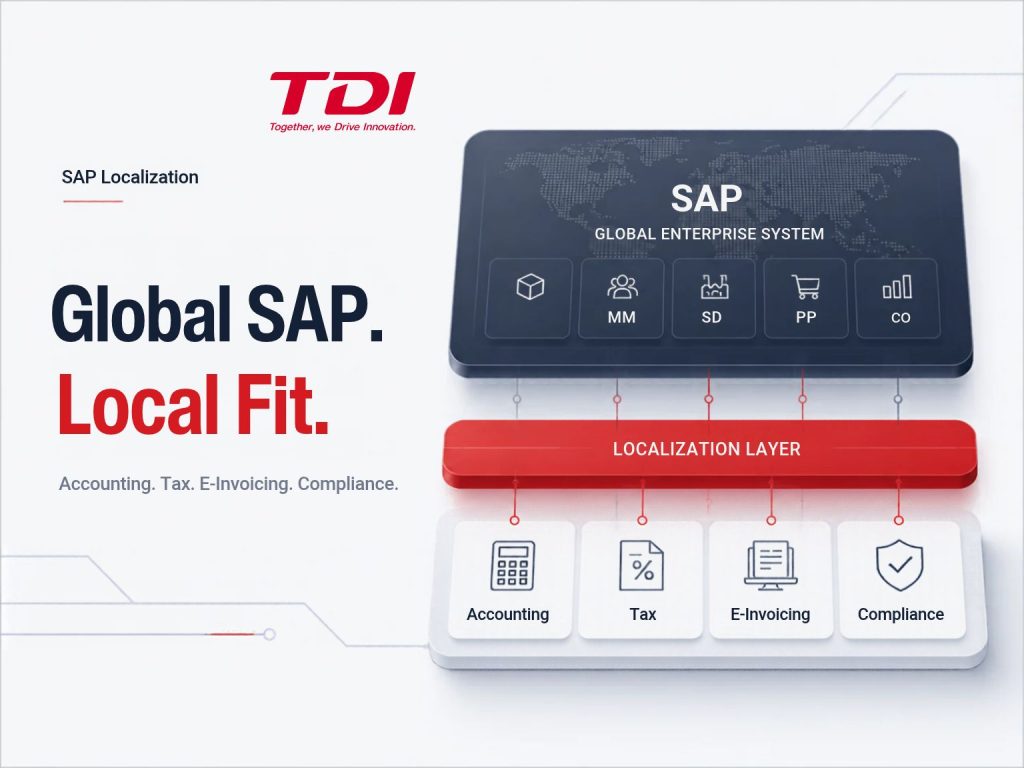
Every local change adds cost to future upgrades and to the next country rollout. A clear owner should decide which requests become part of the template and which stay local.
Either way, the localization work in the checklist below still has to be done.
Country checklist: Vietnam, Malaysia, Singapore and Indonesia
All four countries require, or are phasing in, electronic invoicing or invoice reporting to the tax authority. The details and dates differ.
| Country | What to localize | Change to plan for |
|---|---|---|
| Vietnam | VAS accounting, VAT, e-invoices reported to the tax authority | Circular 99/2025/TT-BTC replaced Circular 200 from 1 January 2026. Decree 254/2026/NĐ-CP replaced Decree 123/2020 and Decree 70/2025 from 1 July 2026. |
| Malaysia | Sales and Service Tax (SST), MyInvois e-invoicing run by LHDN | MyInvois is phased in by company turnover, and LHDN has revised the dates several times. Confirm your phase on LHDN’s website. |
| Singapore | GST, InvoiceNow e-invoicing (Peppol network) | From 1 April 2026, InvoiceNow is required for all new voluntary GST registrants. All GST-registered businesses follow between 2028 and 2031. |
| Indonesia | VAT (PPN), e-Faktur tax invoices | Since January 2025, e-Faktur has moved to the Coretax system. |
Beyond indirect tax and invoicing, check these in all four countries: withholding tax on payments to foreign suppliers, payroll and social insurance (often run in a separate system but posted to accounting), and each bank’s payment file format.
Vietnam
- Accounting: Circular 99 applies to financial years starting on or after 1 January 2026. Review the chart of accounts mapping, financial statement formats and accounting policies.
- E-invoicing: Decree 254 and Circular 91/2026/TT-BTC took effect on 1 July 2026. Review invoice timing, adjustment and replacement flows, and the link between SAP and your e-invoice provider.
Malaysia
- Tax: set up tax codes and reports for both sales tax and service tax.
- E-invoicing: SAP must send invoices to MyInvois, through the LHDN API or an intermediary. Plan this in the design phase, not at the end.
Singapore
- Tax: GST tax codes and the GST return.
- E-invoicing: IRAS has been notifying businesses registered before 2026 of their own InvoiceNow dates. Choosing an InvoiceNow-ready setup during the rollout avoids a second project later.
Indonesia
- Tax: set up VAT (PPN) codes to match current rules. Indonesia changed how VAT is calculated in 2025, so confirm the current treatment with your tax advisor.
- E-invoicing: e-Faktur is issued through Coretax. Test the connection between SAP and Coretax before go-live.
Five common rollout mistakes
- Assuming the global template already covers local rules. It rarely does. In Vietnam, for example, groups usually need two sets of books in SAP: IFRS for group reporting and VAS for local statutory reports. If this gap only shows up in testing, the timeline slips.
- Treating localization as a finance-only task. Tax and invoicing rules also change how sales orders, purchasing, stock movements and returns work. Sales and warehouse users should join the fit-gap workshops too.
- Planning e-invoicing at the end. E-invoicing is not just a new invoice layout. SAP must send each invoice to the tax authority or a licensed provider, then handle rejections and corrections. Choosing the provider, building the connection and testing it all take time, so plan them in the design phase. A 2025 SAPinsider study warns that running e-invoicing separately from the SAP S/4HANA program can cause problems after go-live.
- Saying yes to every “we did it this way before” request. Local teams often ask to copy screens, reports or approval steps from their old system. Each one becomes custom work that must be maintained and retested at every upgrade and every future rollout. For each request, ask one question: is it required by law, by a different business model, or just habit?
- No owner after go-live. Someone must track rule changes and update the system. In 2026 alone, Vietnam replaced both its main accounting circular and its e-invoicing decree.
A practical rollout sequence
- Fit-gap with local finance and tax. Separate legal requirements, business-model differences and habits. This is also the point to decide between a full template rollout and two-tier ERP.
- Check SAP coverage. Confirm what SAP delivers for the country, edition and release. For each gap, decide between SAP standard, a partner add-on or an e-invoice provider.
- Design the local layer. Tax codes, document numbering, statutory reports and payment formats. Ask the local accountant or auditor to review.
- Migrate data. Load master data and opening balances, then reconcile them with the legacy books.
- Test end to end. Include test submissions to the e-invoicing system and a dry run of the first statutory reports.
- Go live with hypercare. Support users through the first month-end close and the first tax filing.
- Assign a regulatory owner. Review local rule changes at least every quarter.
Frequently asked questions
Do we need a separate SAP system for each country?
Usually not. Most groups run one SAP system with a company code per legal entity and activate the local version for each country.
How long does an SAP rollout take?
It depends on the number of entities, the gaps found in fit-gap and the e-invoicing setup. A rollout of a stable template is normally much shorter than a first implementation.
Does SAP support e-invoicing in Southeast Asia?
SAP Document and Reporting Compliance covers e-invoicing and e-reporting for many countries. Coverage depends on the country, your SAP edition and release. Some countries also need a local e-invoice provider connected to the tax authority.
What changed in 2026?
Vietnam replaced Circular 200 with Circular 99 (from 1 January) and Decree 123 with Decree 254 (from 1 July). Singapore extended InvoiceNow to all new voluntary GST registrants from 1 April and announced a 2028 to 2031 timeline for all GST-registered businesses. Malaysia continued its phased MyInvois rollout.
Can one partner handle all four countries?
Yes, if the partner has consultants who know each country’s rules and can work with the SAP team at your headquarters that owns the group design.
How TDI APJ helps
TDI APJ is an SAP Partner serving companies in Vietnam, Malaysia, Singapore and Indonesia. We roll out SAP templates to new subsidiaries and configure local accounting, tax and e-invoicing requirements for each project. As part of the TDI Group in Japan, we work directly with the SAP team at headquarters, keeping the group design intact while meeting each country’s rules.
Our team has rolled out SAP for multinational groups headquartered in Europe, Japan and Korea, across manufacturing, distribution, retail, and pharmaceuticals and healthcare.
Planning an SAP rollout in Southeast Asia? Talk to our team.
This article is general information, not tax or legal advice. Rules change often. Check current requirements with your tax advisor and the relevant authority.