

How Fashion Retailers Win with SAP Cloud ERP — and Why Your SAP Partner Matters
If you run a mid-to-large fashion or retail business in Asia Pacific, the pressures are familiar: shrinking margins, unpredictable demand, legacy systems that can’t connect your stores and e-commerce, and sustainability reporting requirements that feel impossible to fulfill without clean data.
SAP Cloud ERP is purpose-built to address these problems. But technology is only half the equation. The SAP partner you choose to implement it — their regional expertise, industry depth, and execution capability — determines whether you see results or just get a system.
TDI APJ is an SAP consulting and implementation partner operating across Vietnam, Malaysia and Singapore,with experience deploying SAP Cloud ERP for retail and fashion businesses in the Asia Pacific region.

1. The State of Fashion Retail: Why the Pressure Is Real
The fashion and retail sector is navigating compounding pressures from multiple directions. These are not hypothetical risks — industry research confirms them:
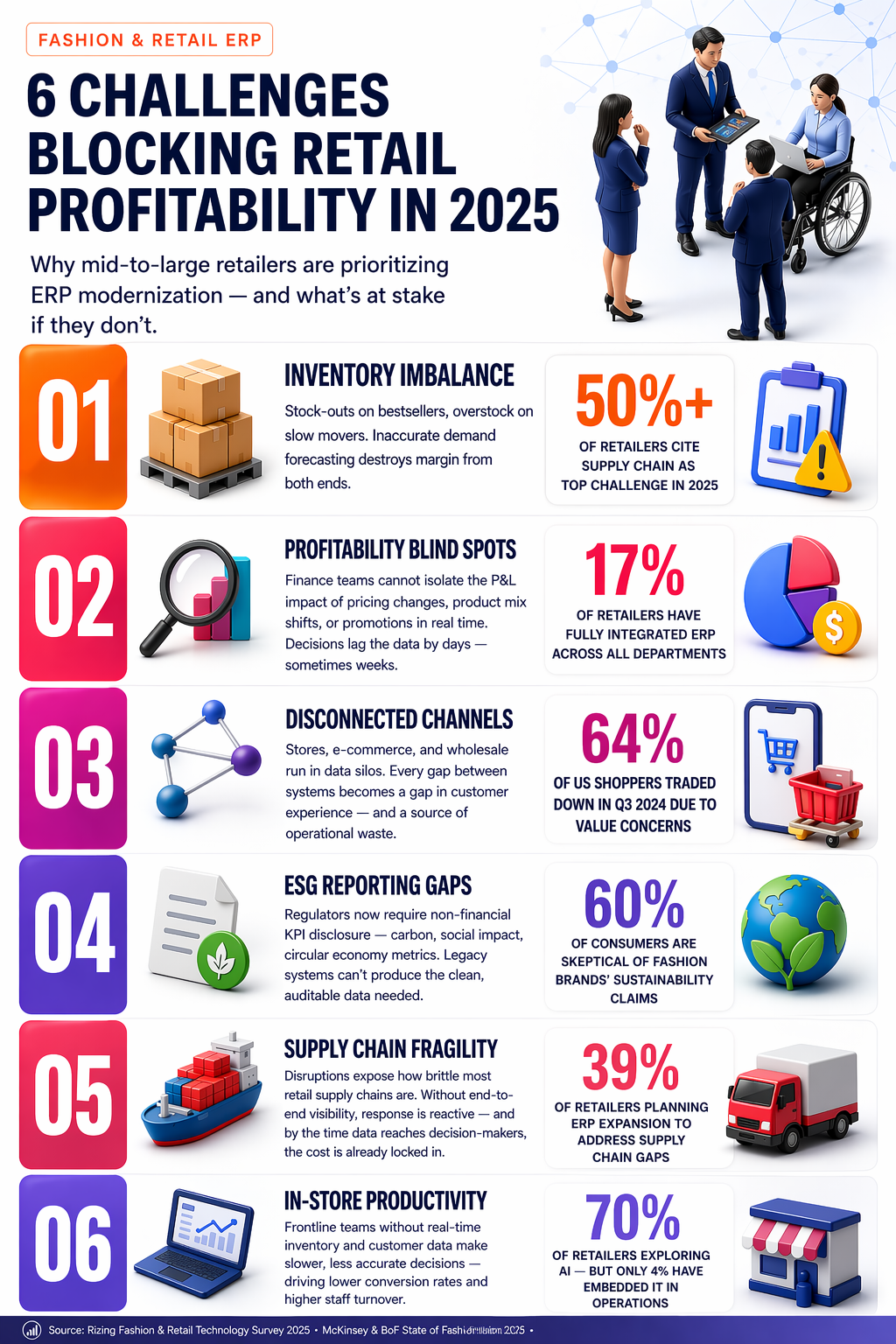
- Consumers are becoming more value-driven: According to the McKinsey & BoF State of Fashion 2025 report, 64% of US shoppers “traded down” in Q3 2024, shifting away from premium clothing to more affordable alternatives. Only 20% of industry leaders expect improvement in consumer sentiment in 2025.
- ERP integration remains incomplete for most retailers: A 2025 industry survey by Rizing found that only 17% of retailers have fully integrated their ERP systems across all departments. Meanwhile, 39% are actively planning ERP expansions — confirming that the majority of the market is still mid-transformation.
- Supply chain volatility is the top external challenge: The same survey found that over 50% of retailers cite supply chain disruptions and economic uncertainty as their top challenges in 2025. Inventory and supply chain management ranked as the #1 investment priority for the year ahead.
- AI is on the agenda but not yet embedded: 70% of retailers say they are exploring AI, but only 4% have embedded it as a core business strategy. The gap between interest and implementation is wide — and the retailers closing that gap first will have a structural advantage.
- Sustainability is now a regulatory issue, not just a brand one: Consumer trust in fashion brands’ sustainability claims is low: research from YouGov shows 60% of global consumers are skeptical of green claims, and 55% report becoming more aware of greenwashing than the year before. Regulators are responding — in 2025, the European Parliament passed new rules requiring apparel producers to cover costs of collecting, sorting, and recycling products.
2. Six Operational Challenges That Directly Impact Margin
Beyond the macro environment, retail and fashion businesses face specific operational pain points that ERP systems are designed to address:
- Inventory imbalance: Inaccurate demand forecasting leads to stock-outs on high-demand products while slow movers accumulate. Both outcomes erode margin.
- Profitability blind spots: Finance teams cannot isolate the P&L impact of pricing changes, seasonal product mix, or promotional spend in real time.
- Disconnected channels: Physical stores, e-commerce, and wholesale operate in data silos — creating friction for customers and operational waste internally.
- ESG reporting gaps: Regulatory pressure to disclose non-financial KPIs (carbon, social impact) is increasing, while legacy systems cannot produce reliable sustainability data.
- Supply chain fragility: Distribution center closures and route disruptions expose how brittle most retail supply chains are when stress-tested.
- In-store productivity: Frontline teams operating without real-time data make slower decisions, contributing to lower conversion rates and higher turnover.
3. Why SAP Cloud ERP Is Built for Retail
SAP Cloud ERP is the market-leading ERP platform for mid-to-large retail businesses. Its advantage over generic ERP platforms is that retail and fashion processes are embedded natively — not added on afterward. For fashion retailers specifically, SAP offers the Retail, Fashion and Vertical Business solution set, covering seasonal assortment planning, markdown optimization, omnichannel order fulfillment, and sustainability tracking.
Key platform capabilities for retail
- Real-time inventory management with commitment-based order confirmation — reducing stock-out risk
- Integrated logistics execution across pick, pack, and ship processes
- Financial close acceleration with granular P&L visibility by channel, product, and region
- AI-driven demand forecasting and trend anticipation
- Native ESG data capture aligned with international reporting standards (CSRD, GRI)
- SAP Customer Checkout (cloud edition) for in-store purchasing integration
- According to SAP Performance Benchmarking, 73% of retailers are prioritizing personalized customer experiences — SAP’s platform enables this at scale
4. Business Outcomes: What SAP Customers Report
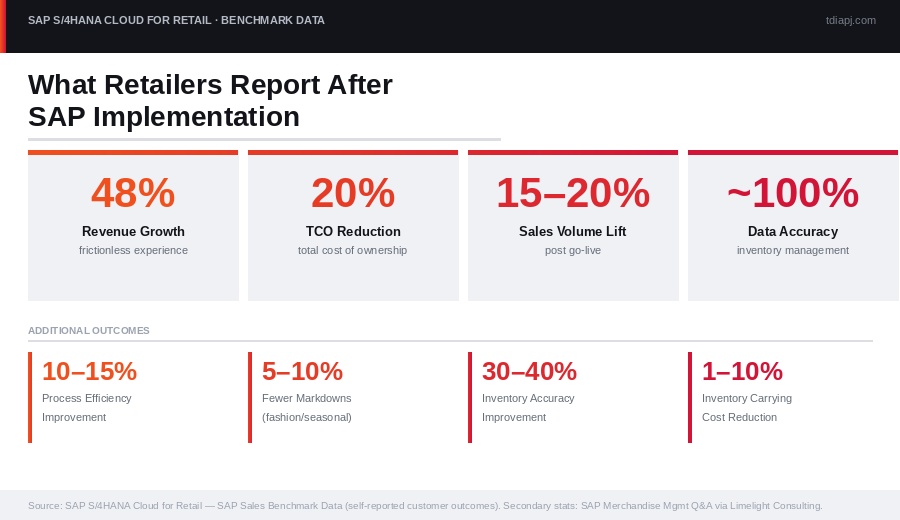
The following outcome ranges come from SAP’s Sales Benchmark Data for the Retail & Fashion vertical. These are self-reported customer benchmarks, not independent research — but they reflect documented implementation results across SAP’s global customer base.
Additional outcome data from SAP’s own product documentation for merchandise management:
- 5–10% fewer markdowns for fashion and consumer electronics retailers through more efficient season management
- 30–40% improvement in inventory accuracy, leading to higher inventory turns
- 10–15% reduction in inventory carrying costs
Independent validation: A Forrester Total Economic Impact study found that organizations implementing SAP S/4HANA experienced an average operational cost reduction of approximately 10% within the first three years.
5. SAP Solutions Relevant to Retail & Fashion
Depending on where a business is in its digital transformation journey, TDI APJ typically implements one or more of the following:
| Solution | What It Addresses |
| SAP S/4HANA Cloud Public Edition | Core ERP: finance, supply chain, operations. Pre-configured for retail. Faster deployment than custom on-premise builds. |
| Retail, Fashion & Vertical Business | Industry-specific modules: assortment management, seasonal planning, markdown optimization, and fashion supply chain. |
| SAP Customer Checkout (Cloud) | Point-of-sale integrated with the ERP — real-time inventory updates and unified in-store experience. |
| SAP Sustainability & ESG | Track, manage, and disclose non-financial KPIs in formats compliant with CSRD, GRI, and other global standards. |
6. Why Your SAP Partner Choice Determines Your Outcome
SAP is the platform. But SAP implementations don’t run themselves. The difference between a successful go-live in months and a multi-year cost overrun is almost entirely determined by your implementation partner.
What separates strong SAP partners for retail:
- Retail-specific expertise. Generic SAP partners configure the system. Retail-specialized partners know the business processes — seasonal planning, markdown logic, omnichannel fulfillment — and configure accordingly.
- Regional presence. Implementation is a people-intensive process. A partner with operations in your market understands local compliance requirements, vendor ecosystems, and change management dynamics.
- Right-sized for your business. Enterprise SAP partners built for Fortune 500 deployments often over-engineer solutions for mid-market retailers.
- Post-go-live commitment. ERP is not a one-time project. The right partner should be invested in your long-term operational performance, not just the implementation contract.
Relevant data point: Prosci research indicates that 70% of change initiatives fail due to lack of proper change management — a risk that is significantly mitigated by partners who integrate change management into the implementation methodology.
7. Why Retail Businesses Choose TDI APJ
- Operating across key Southeast Asian markets including Vietnam, Malaysia, Singapore, and Indonesia, TDI APJ helps businesses leverage regional expertise combined with globally proven SAP implementation methodologies.
- End-to-end SAP consulting and implementation. From business case and solution design through go-live and post-implementation support.
- Industry focus: retail, fashion, and mid-to-large enterprises. Focused practice means faster configuration and implementation teams that understand your business model.
- Backed by TDI Group Japan. TDI APJ operates under a Japanese technology and consulting organization — bringing structured project management and a long-term partnership orientation.
- Aligned with SAP’s current retail roadmap. We deploy SAP’s latest cloud-first product suite: S/4HANA Cloud Public Edition, Retail & Fashion vertical, and SAP’s AI-driven analytics.
Ready to Talk to an SAP Retail Partner?
Tell us about your current systems and business goals. We will map the right SAP solution and outline a realistic timeline for your business.
Contact TDI APJ: marketing@tdiapj.com