

How Fashion Retailers Win with SAP Cloud ERP — and Why Your SAP Partner Matters
If you run a mid-to-large fashion or retail business in Asia Pacific, the pressures are familiar: shrinking margins, unpredictable demand, legacy systems that can’t connect your stores and e-commerce, and sustainability reporting that feels impossible without clean data.
SAP for fashion retail, specifically SAP Cloud ERP, is built to address these problems. But technology is only half the equation. The SAP partner you choose, with their regional knowledge, industry depth and execution capability, decides whether you see real results or just get another IT system.
TDI APJ is an SAP partner for consulting and implementation in Vietnam, Malaysia, Singapore and Indonesia, with experience supporting retail and fashion businesses across the region.

1. The state of fashion retail: pressure from every direction
The fashion and retail sector is dealing with pressures from several directions at once:
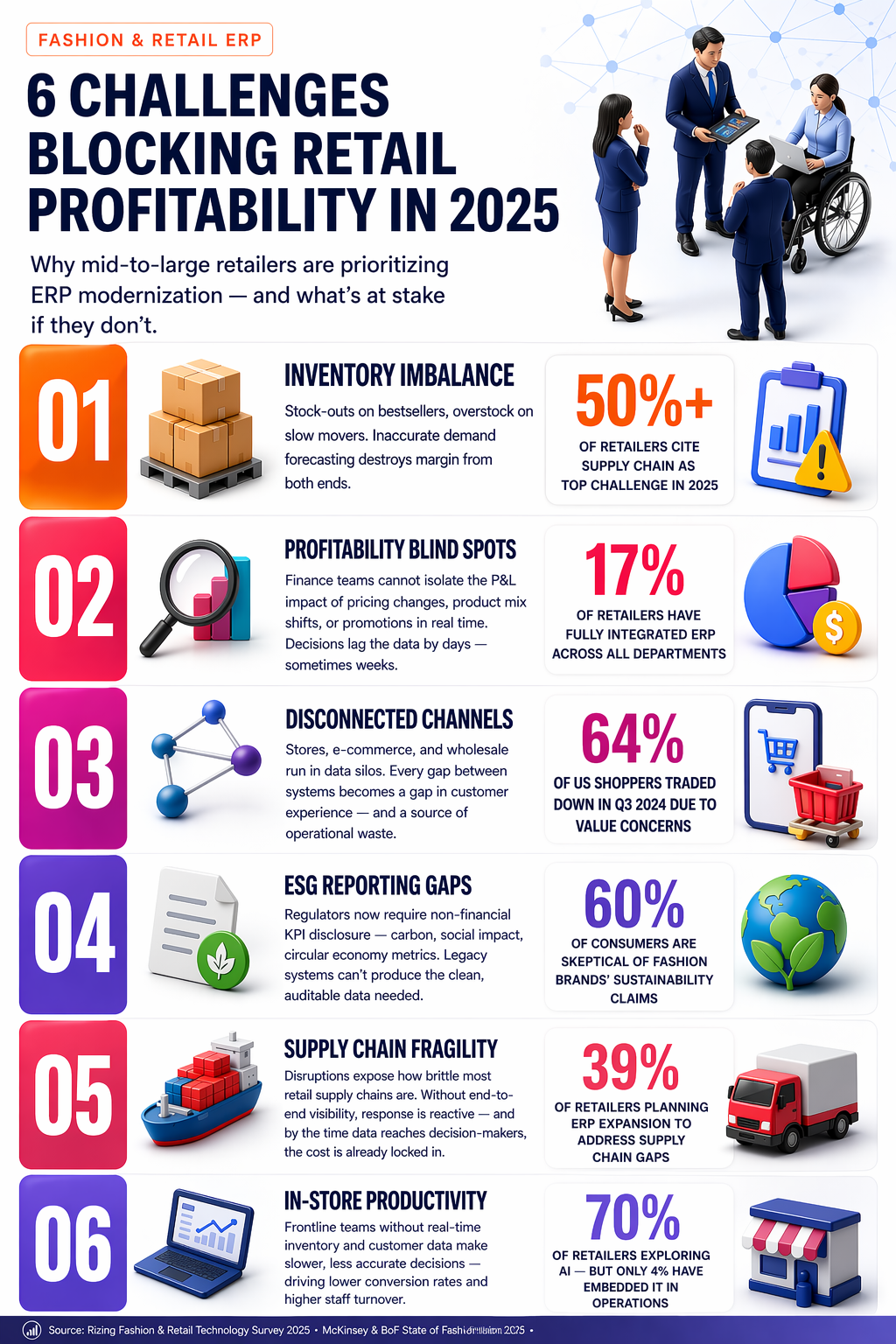
- Consumers are becoming more value-driven: according to McKinsey & BoF’s The State of Fashion 2025, 64% of US shoppers “traded down” in Q3 2024, moving from premium clothing to more affordable options. Only 20% of industry leaders expect consumer sentiment to improve in 2025.
- Many retailers have not fully integrated their ERP: in many businesses, departments still run on separate systems, and extending ERP across the company is still on the roadmap.
- Supply chain volatility: supply chain disruption and economic uncertainty remain among retailers’ top challenges, making inventory and supply chain management a priority for investment.
- AI is on the agenda but not yet embedded: most retailers are still exploring or piloting AI, and few have made it central to their strategy. Those who move early, and in the right way, will gain a clear advantage.
- Sustainability is now a regulatory issue: consumers are increasingly skeptical of unsupported green claims, and regulators are tightening rules. In 2025, the European Parliament passed rules requiring apparel producers to cover the costs of collecting, sorting and recycling products.
2. Six operational challenges that erode margin
Beyond the market environment, retail and fashion businesses face specific operational pain points, the same ones ERP systems are designed to address:
- Inventory imbalance: inaccurate forecasting leads to stock-outs on best sellers while slow movers pile up. Both erode margin.
- Profitability blind spots: finance cannot isolate the P&L impact of pricing changes, seasonal product mix or promotional spend in real time.
- Disconnected channels: stores, e-commerce and wholesale run in separate data silos, creating friction for customers and waste internally.
- ESG reporting gaps: pressure to disclose non-financial KPIs (carbon, social impact) is rising, while legacy systems cannot produce reliable sustainability data.
- Supply chain fragility: a single distribution center closure or route disruption shows how fragile many retail supply chains are.
- In-store productivity: frontline teams without real-time data make slower decisions, which lowers conversion.
3. Why SAP Cloud ERP fits fashion retail
What sets SAP Cloud ERP apart from generic ERP is that retail and fashion processes are built in, not added later. SAP offers dedicated solutions for Retail, Fashion and Vertical Business, covering seasonal assortment planning, markdown optimization, omnichannel order fulfillment and sustainability tracking.
Key capabilities for retail
- Real-time inventory with availability-based order confirmation, reducing stock-outs.
- Integrated logistics across pick, pack and ship.
- Faster financial close with detailed P&L by channel, product and region.
- AI-driven demand forecasting and trend detection.
- Built-in ESG data capture aligned with international reporting standards such as CSRD and GRI.
- Personalized customer experiences at scale. According to SAP benchmark data, 73% of retailers are prioritizing personalization.
4. Business outcomes: what SAP customers report
The outcome ranges below come from SAP’s Sales Benchmark Data for retail and fashion. They are self-reported by SAP customers worldwide, not independent research, and not results from a specific TDI APJ project.
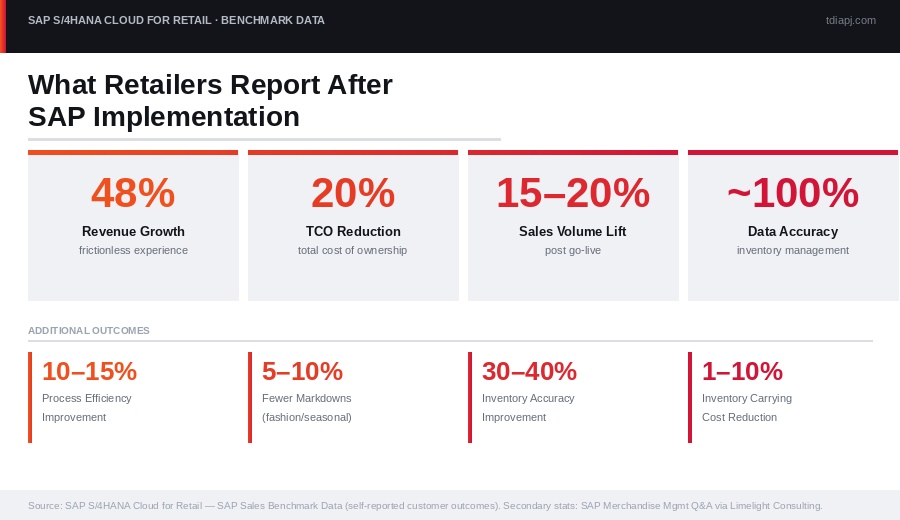
According to SAP’s product documentation for merchandise management, businesses can achieve:
- 5–10% fewer markdowns through better season management in fashion and consumer electronics.
- 30–40% better inventory accuracy, leading to higher inventory turns.
- 10–15% lower inventory carrying costs.
5. Solutions for retail and fashion
Depending on where a business is in its transformation, TDI APJ typically implements one or more of the following:
| Solution | What it addresses |
| SAP Cloud ERP | Core ERP: finance, supply chain and operations. Pre-configured for retail, faster to deploy than custom on-premise builds. |
| SAP Retail, Fashion & Vertical Business | Industry modules: assortment management, seasonal planning, markdown optimization and fashion supply chain. |
| RetailPlus FrontOffice | Retail POS developed by TDI APJ, connected directly to the ERP for real-time inventory and a consistent in-store experience. |
| SAP Sustainability & ESG | Track, manage and disclose non-financial KPIs in line with CSRD, GRI and other global standards. |
6. Choosing an SAP partner: the factor that decides the outcome
SAP is the platform, but it does not implement itself. The difference between a go-live in months and a multi-year project over budget lies largely with the implementation partner.
A strong SAP partner for retail brings:
- Retail expertise: they understand seasonal planning, markdown logic and omnichannel fulfillment, and configure the system around how you actually operate.
- A team in your market: they know local compliance, the vendor ecosystem and how to manage change in your context.
- The right scale: partners used to very large enterprise projects often over-engineer solutions for mid-market retailers.
- Commitment after go-live: ERP is not a one-off project. The right partner stays invested in your long-term performance.
Change management is often underestimated. Many transformation programs fail because people are not ready, not because of the technology. That risk drops significantly when the partner builds change management into the implementation approach from day one.
7. Why retail businesses choose TDI APJ
- Present in Vietnam, Malaysia, Singapore and Indonesia, combining regional knowledge with proven SAP implementation methods. TDI APJ has delivered 300+ SAP projects in 15+ countries.
- End-to-end support: from business case and solution design to go-live and post-implementation support.
- Focus on retail and fashion, with our own solutions such as RetailPlus and RetailPlus FrontOffice.
- Part of the TDI Group (Japan): structured project management and a long-term partnership approach.
- Aligned with SAP’s direction: we implement SAP Cloud ERP, SAP’s Retail & Fashion industry solutions and SAP’s AI-driven analytics.
Read more: Why modern retailers are turning to Cloud ERP and SAP for retail: key FAQs.
Ready to talk to an SAP retail partner?
Tell us about your current systems and business goals. We will recommend the right SAP solution and a realistic implementation roadmap. Contact TDI APJ or email marketing@tdiapj.com.